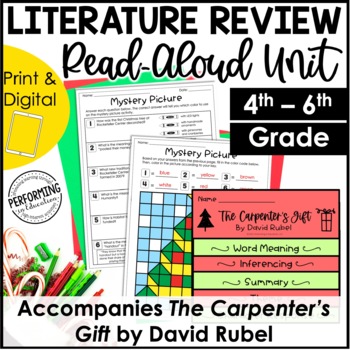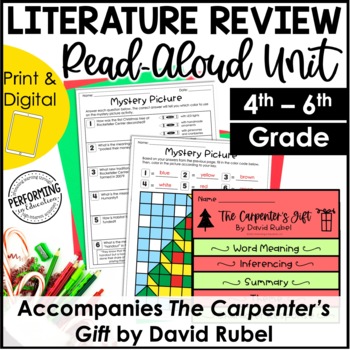
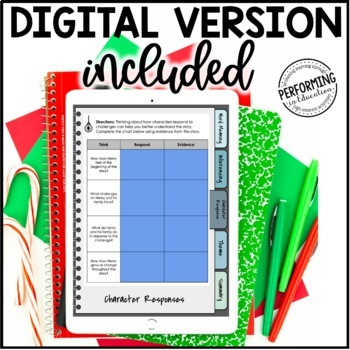
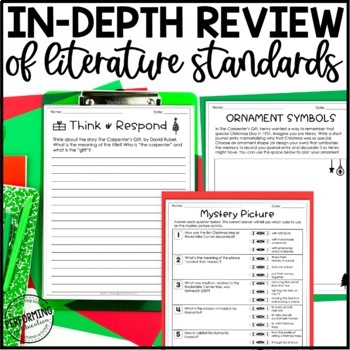
December Read-Aloud Unit | Use With The Carpenter’s Gift | 4th – 6th Grade
$ 4.50
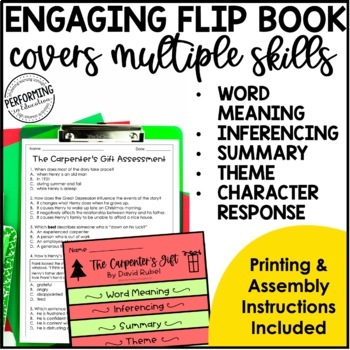
This seasonal literary unit is perfect for the month of December and Christmas. This resource focuses on reviewing literature standards through the use of the picture book The Carpenter‚Äôs Gift, by David Rubel.¬† You will need a copy of this book for use throughout the unit. You may be able to find a read aloud of the book on YouTube. Students will be creating a flip book to complete as you work through the unit. Each flip book is created with three pieces of paper printed front and back, staggered, and folded. Detailed instructions, including video tutorials, are provided to help with printing and assembling the flip books. Unit Includes: Word Meaning Inferencing Summary Theme Character Response Assessment Written Response STANDARDS: FOURTH GRADE CCSS.ELA-LITERACY.RL.4.1Refer to details and examples in a text when explaining what the text says explicitly and when drawing inferences from the text. CCSS.ELA-LITERACY.RL.4.2Determine a theme of a story, drama, or poem from details in the text; summarize the text. CCSS.ELA-LITERACY.RL.4.3Describe in depth a character, setting, or event in a story or drama, drawing on specific details in the text (e.g., a character’s thoughts, words, or actions). CCSS.ELA-LITERACY.RL.4.4Determine the meaning of words and phrases as they are used in a text, including those that allude to significant characters found in mythology (e.g., Herculean). FIFTH GRADE CCSS.ELA-LITERACY.RL.5.1Quote accurately from a text when explaining what the text says explicitly and when drawing inferences from the text. CCSS.ELA-LITERACY.RL.5.2Determine a theme of a story, drama, or poem from details in the text, including how characters in a story or drama respond to challenges or how the speaker in a poem reflects upon a topic; summarize the text. CCSS.ELA-LITERACY.RL.5.3Compare and contrast two or more characters, settings, or events in a story or drama, drawing on specific details in the text (e.g., how characters interact). CCSS.ELA-LITERACY.RL.5.4Determine the meaning of words and phrases as they are used in a text, including figurative language such as metaphors and similes. CCSS.ELA-LITERACY.RL.5.5Explain how a series of chapters, scenes, or stanzas fits together to provide the overall structure of a particular story, drama, or poem. SIXTH GRADE CCSS.ELA-LITERACY.RL.6.1Cite textual evidence to support analysis of what the text says explicitly as well as inferences drawn from the text. CCSS.ELA-LITERACY.RL.6.2Determine a theme or central idea of a text and how it is conveyed through particular details; provide a summary of the text distinct from personal opinions or judgments. CCSS.ELA-LITERACY.RL.6.3Describe how a particular story’s or drama’s plot unfolds in a series of episodes as well as how the characters respond or change as the plot moves toward a resolution. CCSS.ELA-LITERACY.RL.6.4Determine the meaning of words and phrases as they are used in a text, including figurative and connotative meanings; analyze the impact of a specific word choice on meaning and tone. CCSS.ELA-LITERACY.RL.6.5Analyze how a particular sentence, chapter, scene, or stanza fits into the overall structure of a text and contributes to the development of the theme, setting, or plot. ***************************************************************************
You may also like…
-
 Hot
Sale
Hot
Sale
Author’s Point & Reasons Read-Aloud | Use with Book What if Everybody Did That
$ 4.50 This product has multiple variants. The options may be chosen on the product page -
 Sale
Sale
Author’s Purpose & Point of View | Use with Book A Poem for Peter | 6th Grade
$ 4.50 This product has multiple variants. The options may be chosen on the product page